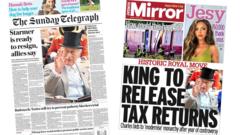
The traditional buffer zones of British governance are dissolving right in front of us. When a Prime Minister finds himself in a defensive crouch regarding his own political survival and the reigning monarch prepares to bare his private financial records to the public, the old rules of institutional self-preservation no longer apply.
We aren't looking at a couple of isolated, standard political speedbumps. We're witnessing a fundamental pivot in how public figures in the UK are forced to manage authority, reputation, and exposure.
The immediate pressures bear down heavily on two fronts: Sir Keir Starmer's escalating battle to retain control of his party following the explosive fallout from a high-profile diplomatic appointment, and King Charles III's unprecedented move toward radical financial openness in the wake of renewed external scrutiny.
The Starmer Crisis and the Mandelson Trap
The speculation surrounding the Prime Minister's future isn't just standard Westminster chatter. It's a full-blown existential crisis for the Labour leadership, triggered directly by the controversial appointment of Lord Mandelson as the UK’s ambassador to the United States.
The timeline of this crisis reveals a series of severe miscalculations that left Number 10 totally exposed.
- December 2024: Sir Keir Starmer fields significant internal and public warnings to nominate Lord Mandelson for the Washington diplomatic post.
- September 2025: Starmer is forced to abruptly dismiss Mandelson following the public leak of highly damaging email exchanges between the two men.
- June 2026: The situation hits a breaking point. The US Justice Department releases documents indicating that Mandelson allegedly leaked market-sensitive data to Jeffrey Epstein during his past tenure as a government minister.
The political fallout from these disclosures has been brutal and fast. Rather than containing the damage, the initial departures of Chief of Staff Morgan McSweeney and the Downing Street head of communications only highlighted the depth of the error. High-ranking party figures, including Scottish Labour Leader Anas Sarwar, openly stated that Starmer must step down for the good of the country.
The recent Makerfield byelection victory by Andy Burnham has significantly heightened the tension. Burnham's return to Westminster provides a highly visible alternative leader for a parliamentary party that is increasingly anxious about Starmer’s judgment and sliding poll numbers. For a Prime Minister who built his entire political brand on the concept of ruthless professionalism and clean governance, this specific scandal cuts right through his core defense.
The Royal Tax Move Change
While Downing Street scrambles to manage a political rebellion, Buckingham Palace is executing a completely different kind of damage control. King Charles III is preparing to release his personal tax returns, an extraordinary break from the historical privacy usually guarded by the House of Windsor.
This isn't happening in a vacuum. The decision follows the unsealing of the Epstein files, documents that once again brought uncomfortable historical associations into the public eye, impacting both the government and the wider circle of the royal family.
By choosing proactive transparency, the Palace is attempting to build a firewall against public anger. They recognize a reality that Number 10 missed: in the current cultural environment, withholding information is automatically treated as an admission of guilt.
For the King, publishing tax data serves a dual purpose. It addresses the growing public demand for institutional accountability while drawing a very deliberate, sharp contrast between the Palace's swift response and the agonizing, defensive delays coming out of Downing Street.
The High Cost of Defensive Politics
There's a critical lesson here about how power operates today. Starmer’s current vulnerability isn't just due to the initial mistake of backing Mandelson; it’s a direct result of trying to manage the fallout using an obsolete political playbook.
When you stonewall, offer partial explanations, or sacrifice staff members while protecting the core decision-maker, you don't buy time anymore. You just feed the news cycle.
The Palace looked at the landscape and chose an aggressive counter-strategy: offer up the data before the public demands it. It’s a calculated risk, but it shifts the narrative from a defensive cover-up to an act of voluntary accountability.
What Happens Next
The immediate path forward requires concrete changes from both institutions if they want to stabilize their positions.
First, Downing Street needs to abandon its current defensive posture. Starmer cannot rely on vague promises of "getting on with the job" or expecting party loyalty to pull him through. Number 10 must immediately lay out an explicit, clear framework for how future high-level diplomatic appointments are vetted, effectively stripping away the cronyism accusations that are currently fueling the rebellion.
Second, the Prime Minister needs to address his party's internal critics head-on by establishing an independent review into the Mandelson appointment files. Trying to outlast the news cycle will fail; the pressure from the backbenches and the shadow cast by Burnham's return are simply too great.
On the other side of London, the Palace must ensure that its financial disclosures are genuinely comprehensive. If the King’s tax returns are seen as overly curated or lacking real substance, the entire strategy will backfire terribly, turning a bid for transparency into a fresh wave of public skepticism.
The era of managed, top-down institutional privacy in British life is officially over. Whether you're running the government or sitting on the throne, your survival now depends on how quickly you realize that secrecy is no longer a viable strategy.