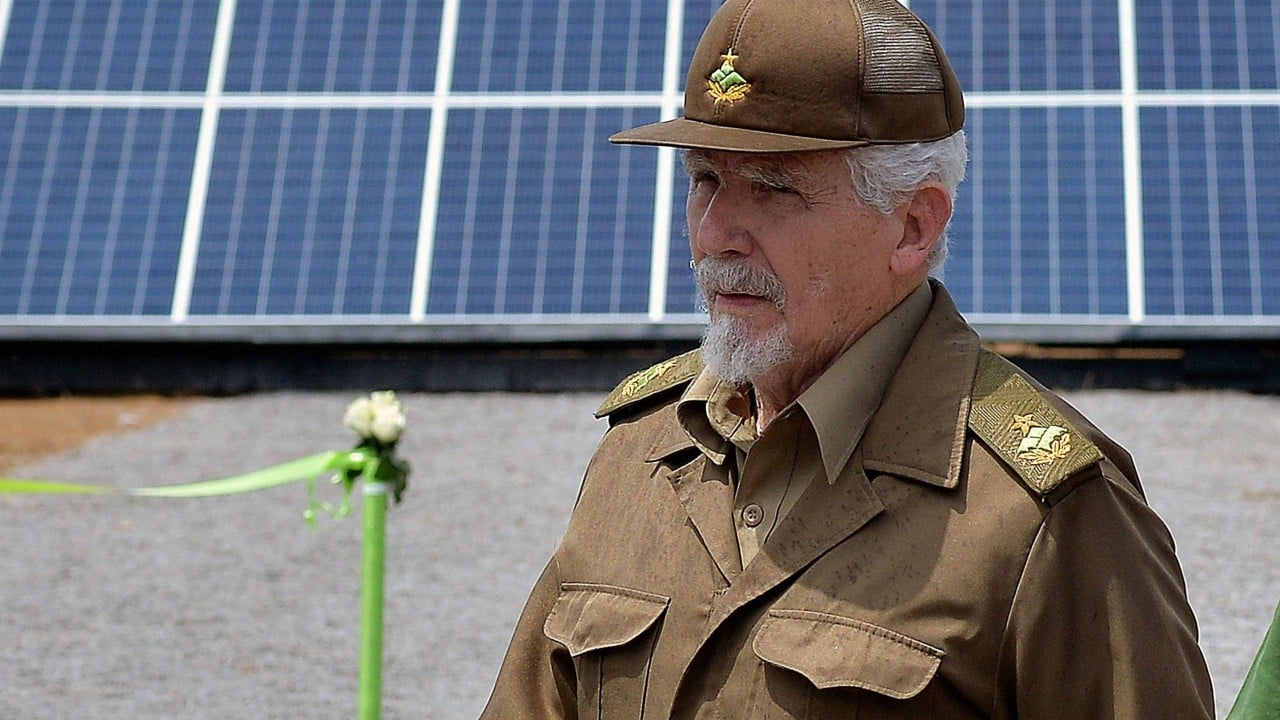
The last of the old guard is slipping away. With the death of Ramiro Valdes Menendez at age 94, Cuba has lost more than just another historical figure wearing faded green fatigues. The island lost the chief architect of its domestic surveillance network, a man who built the very apparatus that kept the Cuban Communist Party in absolute control for over six decades.
When President Miguel Diaz-Canel announced Valdes's passing on June 21, 2026, he used the kind of emotional language you expect from a loyal political heir. He said the loss felt like the death of a father. But outside the official state media broadcast rooms, the reaction across Havana and the wider Cuban diaspora in Miami carries a completely different weight. For millions of Cubans, Valdes wasn't just a revolution hero. He was the feared enforcement hand of the regime.
If you want to understand how a small island nation managed to withstand ten US presidents, an economic embargo, and the total collapse of its primary benefactor in the Soviet Union, you have to look directly at the work of Ramiro Valdes. He didn't just participate in history. He built the modern Cuban security state from scratch.
The Survivor of the Granma and Moncada
Most people know about Fidel and Raul Castro, or the iconic face of Ernesto "Che" Guevara stamped onto t-shirts worldwide. Valdes operated in the dark shadows just behind them. Born into a poor family in Artemisa on April 28, 1932, he didn't have a background in political theory or elite law schooling like Fidel. He was a street-level fighter from the start.
He joined the fight against Fulgencio Batista's US-backed dictatorship when he was barely out of his teens. Valdes was right there alongside Fidel during the catastrophic 1953 assault on the Moncada Barracks. That raid failed spectacularly, landing him in prison. After an amnesty freed the rebels, he fled to Mexico, only to pack himself onto the famous Granma yacht in 1956.
The voyage was a mess. Eighty-two men crammed into a vessel meant for twelve, battling seasickness and bad engines, only to run aground in a mangrove swamp where Batista's troops were already waiting. Most of the rebels died or got captured within days. Valdes was one of the legendary twelve survivors who managed to escape into the Sierra Maestra mountains to launch a guerrilla war.
In the mountains, he proved his absolute ruthlessness. He served as second-in-command to Che Guevara's guerrilla column. Che valued loyalty and discipline above everything else, and Valdes delivered both without hesitation. When the rebel army swept into Havana in January 1959, Valdes wasn't a celebrity intellectual. He was an executioner of the old regime's loyalists and a battle-hardened commander.
Building the Feared G2 Intelligence Machine
Winning a guerrilla war is one thing. Maintaining absolute control over a population while a superpower ninety miles away wants you dead is a completely different challenge. That became Valdes's true life work.
In 1961, Fidel named him Cuba's first Interior Minister. He was still in his late twenties. To learn how to run a proper secret service, Valdes went straight to the experts. He joined Raul Castro on a trip to Czechoslovakia to receive advanced intelligence training from Soviet bloc agents.
When he came back, he formed the G2 state security intelligence service. The goal wasn't just to catch CIA spies or stop assassination plots, though they did plenty of that. The true purpose was domestic containment. Valdes famously admitted decades later that the system was built so that nobody could move without security knowing about it. They infiltrated counter-revolutionary organizations before those groups could even hold a second meeting.
He organized the Committees for the Defense of the Revolution. These are neighborhood watch groups on literally every block in Cuba. Your neighbor wasn't just a neighbor anymore. They were eyes and ears for Valdes's ministry. They noted who visited your house, what time you came home, and whether you expressed any discontent with the rationing lines. It was a masterpiece of human intelligence gathering that practically eliminated organized internal dissent.
During the roughest patches of the 1960s, Valdes presided over the forced labor camps known as the UMAP. These camps held political dissidents, religious observers, and homosexuals, all deemed unfit for the new socialist man that Guevara envisioned. Valdes didn't care about bad press or international condemnation. He cared about survival.
The Unexpected Fall and the Technology Resurrection
You might think absolute loyalty guarantees a permanent spot at the top of a communist regime. It doesn't. Valdes found that out the hard way. He had a fierce temper and ran into personal rivalries with other powerful comandantes.
In 1969, the Politburo stripped him of his ministry post. He managed to claw his way back to the Interior Ministry in 1978, only to get purged again in 1986. By the time the Third Party Congress wrapped up that year, Valdes was stripped of his Politburo seat. To outside observers, his political career looked completely dead. He was banished to run a tiny, obscure state electronics entity called Copextel.
This banishment tells you everything you need to know about his adaptability. Instead of fading into retirement, Valdes turned Copextel into the central hub for Cuba's entire telecommunications, software, and information technology development. He built deep business associations with electronic firms in Japan, South Korea, and China.
By the late 1990s, this tiny electronics group became the most important asset within Cuba's industrial framework. When Raul Castro formally took over the presidency from a failing Fidel in 2008, he brought his old Granma comrade right back into the inner circle. Valdes was readmitted to the Politburo and named Minister of Informatics and Communications.
His perspective on technology was purely tactical. He didn't see the internet as a tool for human expression or economic freedom. In 2007, during an international communications conference in Havana, he gave a speech where he called the internet a tool for global extermination wielded by the United States. He explicitly warned his subordinates that the wild colt of new technologies must be controlled.
He made sure it was. Cuba's internet infrastructure was built to be intentionally slow, expensive, and heavily monitored. He prioritized connection access for state enterprises and university networks where users could be watched, while leaving ordinary citizens in the dark for years. Even when mobile data finally arrived on the island years later, the state retained the power to kill the kill-switch on the entire network whenever protests flared up.
The Venezuelan Connection and Exporting Surveillance
Valdes's mastery of control wasn't confined to Cuban borders. When Hugo Chavez took power in Venezuela, launching his Bolivarian Revolution, Cuba found a new economic lifeline. But it wasn't a one-way street. Cuba didn't just receive cheap oil. They paid for it with security expertise.
In February 2010, Raul Castro dispatched Valdes to Caracas. Officially, he went to advise the Venezuelan government on an acute energy crisis and power grid shortages. The Venezuelan political opposition knew better. They shouted from the rooftops that the legendary Cuban spy chief wasn't there to fix electrical transformers. He was there to reorganize Venezuela's intelligence services.
Under Nicolas Maduro, that cooperation only deepened. Valdes helped implement the Cuban model of domestic intelligence within the Venezuelan military and state apparatus. Cuban agents became bodyguards for high-ranking Venezuelan officials, ensuring that coup plots were intercepted before they could materialize. The same tracking techniques Valdes perfected in Havana during the Cold War were modernized to keep the Maduro government afloat during massive street protests and economic collapse.
What Happens to Cuba Now
With Valdes gone, Raul Castro stands as one of the final remaining living connections to the 1956 Granma voyage. The historic generation is almost entirely buried. The current president, Miguel Diaz-Canel, belongs to a younger generation that didn't fight in the mountains. They don't carry the automatic revolutionary legitimacy that Valdes possessed just by walking into a room in his olive greens.
The country Valdes leaves behind is fractured. Cuba is currently enduring its worst economic crisis since the Special Period of the 1990s. Food shortages are rampant. Electrical blackouts roll through provinces for twelve to fourteen hours a day. Inflation has made the local currency virtually worthless, and a massive wave of migration has seen hundreds of thousands of young Cubans flee the island for the United States or Europe over the last few years.
Without the raw authority of the original comandantes, the current government relies entirely on the cold, institutional machinery of the security state that Valdes engineered. They don't have Fidel's charisma, but they still have Valdes's cameras, his informants, and his internet filters.
Real Steps for Understanding the Changing Cuban Dynamic
If you're tracking the political stability of the Caribbean or studying authoritarian survival strategies, don't look at official government press releases about Valdes's funeral. Watch these specific markers instead.
First, track internet censorship metrics during local disruptions. Watch how quickly the Cuban state cuts off access to applications like WhatsApp or Telegram whenever small-scale protests break out in provinces like Santiago de Cuba or Guantanamo. This direct application of Valdes's tech-control doctrine tells you exactly how terrified the current leadership is of horizontal communication among citizens.
Second, observe the internal movements within the Ministry of the Interior, known locally as MININT. Look for whether younger, tech-focused intelligence officers trained in cyber warfare are replacing the old-school military officers who earned their ranks through historical loyalty. The balance of power between the traditional armed forces and the domestic security services will determine how the regime handles the inevitable post-Castro transition.
Third, monitor the flow of security personnel between Havana and Caracas. With Venezuela facing its own profound political crossroads, any reduction or shift in Cuban advisory roles could signal that Havana is pulling its resources back home to focus entirely on its own domestic survival.
Ramiro Valdes lived long enough to see the world change completely around him, yet he spent his entire existence ensuring his island remained trapped in a permanent state of political amber. His death removes a pillar of historical authority, leaving a hyper-surveilled state running on empty fuel, managed by bureaucrats who lack the revolutionary mystique of the men who came down from the mountains in 1959.